The Unexpected Deal: Why the Most Valuable Conversations Happen Between Sessions
Photo: Anesu gerry rasgam, CC BY-SA 4.0, via Wikimedia Commons
Ask any seasoned executive to recall the partnership, client relationship, or career pivot that changed everything, and you will likely hear a story that begins with the words "we just happened to be standing near each other." It rarely starts with a scheduled breakout session or a formal pitch meeting. More often, it begins in a hallway.
This phenomenon — the serendipitous business encounter — is not merely anecdotal folklore. It represents a legitimate, measurable driver of commercial growth, one that conference designers, corporate event planners, and business center operators have begun to treat with the same seriousness they once reserved only for keynote programming.
The Science Behind Spontaneous Connection
Research from organizational behavior studies consistently demonstrates that weak-tie relationships — those formed through brief, unexpected interactions rather than deep professional familiarity — are disproportionately responsible for career advancement and new business formation. Sociologist Mark Granovetter's foundational work on network theory established decades ago that information and opportunity flow most freely through acquaintances rather than close colleagues.
In practical terms, this means the person you met while waiting for a coffee refill at a conference may be more commercially valuable to you than the contact you have known for five years. The reason is straightforward: people in your existing network largely know what you already know. The stranger in the corridor carries genuinely novel information, perspectives, and access.
At professional gathering spaces across the United States, this insight has begun reshaping how physical environments are conceived and constructed.
How Space Design Encourages Organic Exchange
Event professionals who specialize in conference center management have grown increasingly deliberate about what might be called "productive friction" — the intentional placement of gathering points that slow foot traffic and encourage people to pause and interact.
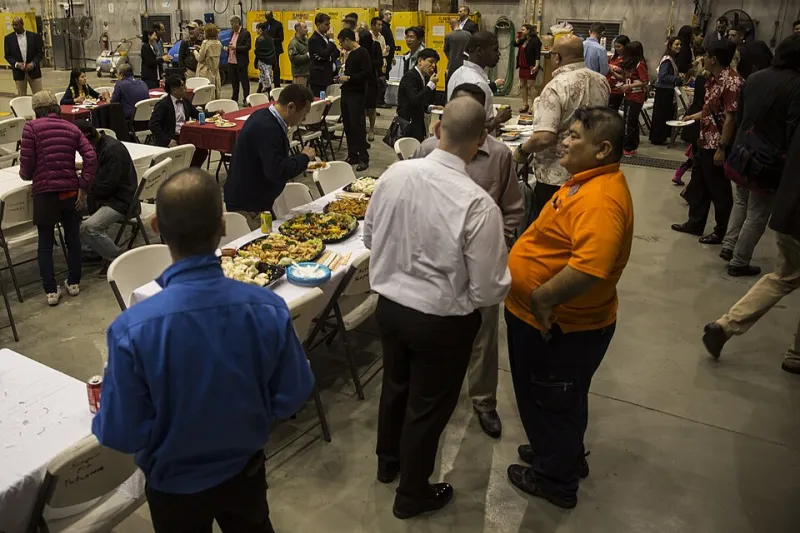
Rather than designing purely efficient pathways between rooms, forward-thinking venues now incorporate what some architects describe as "collision zones": open lounge areas positioned between session rooms, standing-height tables clustered near registration desks, and refreshment stations located away from the main flow of foot traffic so that attendees must linger rather than grab and go.
The logic is straightforward. When people are moving with purpose toward a destination, they do not stop to talk. When an environment gives them a comfortable reason to slow down — a place to set a cup, a view worth pausing for, a seating arrangement that invites a brief exchange — the probability of spontaneous conversation rises dramatically.
Lighting also plays a role that is easy to underestimate. Spaces that feel warm and semi-private, rather than open and surveilled, encourage people to engage more candidly. A conference center that invests in varied lighting environments throughout its common areas is, in effect, investing in the quality of the conversations that take place within them.
Real Outcomes From Unscripted Moments
The commercial consequences of these encounters are well documented, even if the encounters themselves resist documentation.
Consider the trajectory of numerous technology firms that trace their founding partnerships to industry trade gatherings. In the early days of Silicon Valley's annual conference circuit, it was widely understood that the real deals were not made during panel discussions — they were made at the hotel bar afterward, or in the parking structure while waiting for a rideshare. That cultural understanding has since migrated into mainstream corporate America.
A marketing agency principal in Chicago once described landing her firm's largest retainer after a chance conversation at a business center networking breakfast. She had arrived early and found herself seated next to a manufacturing company's VP of Communications. Neither had intended to meet the other. The formal programming that morning produced no immediate results. That breakfast conversation, however, led to a contract signed six weeks later.
These stories are not exceptional. They are representative of how a significant portion of B2B relationships actually form in the United States — not through formal procurement processes or cold outreach, but through the accumulated trust that emerges from an unguarded, low-stakes exchange.
Strategies for Making Serendipity Less Accidental
While genuine spontaneity cannot be manufactured, professionals can take deliberate steps to increase their exposure to it.
Arrive early and stay late. The periods immediately before and after formal programming are when the most candid conversations occur. Attendees who leave promptly at the conclusion of each session forfeit the majority of their serendipitous opportunity.
Resist the pull of familiar faces. At any professional gathering, the instinct to gravitate toward people you already know is powerful and understandable. It is also commercially limiting. Make a practice of introducing yourself to at least two people you have never met before reconnecting with existing contacts.
Use transitional spaces intentionally. Hallways, lobbies, and outdoor terraces are not dead time between scheduled events. Treat them as primary networking environments rather than intervals to be endured.
Follow up within 24 hours. The half-life of a spontaneous connection is short. A brief, personalized message sent the same day or the following morning transforms a pleasant exchange into a professional relationship with genuine continuity.
Share something real. The conversations that convert into lasting business relationships almost always involve some disclosure beyond job title and company affiliation. A shared frustration about an industry challenge, a genuine enthusiasm for a particular approach, or even a personal detail offered in passing creates the kind of memorable impression that a formal elevator pitch rarely achieves.
The Role of the Conference Environment
For organizations selecting venues for corporate events, team retreats, or industry gatherings, the physical characteristics of the space carry real strategic weight. A facility that treats its common areas as afterthoughts — narrow corridors, uncomfortable seating, poor acoustics in shared spaces — is inadvertently suppressing the relationship-formation that justifies the investment in gathering in the first place.
The most effective business centers understand that their value proposition extends well beyond square footage and audiovisual capability. They are, at their best, environments engineered for the kind of human connection that drives commerce forward. Every design decision, from the placement of a refreshment station to the acoustical treatment of a lounge area, either supports or undermines that core purpose.
When professionals gather with the right intentions in the right environment, the hallway becomes the most productive room in the building.