The Return to the Room: Why Distributed Companies Are Booking More Conference Space Than Ever
Photo: remote team corporate retreat modern conference center meeting, via infomascota.com
When the pandemic-era shift to remote work prompted widespread predictions about the obsolescence of physical office space, few analysts anticipated this particular outcome: the companies most committed to distributed work models would become some of the most active consumers of professional meeting facilities.
Yet that is precisely what has unfolded across the United States over the past several years. From technology firms headquartered in Austin with employees spread across a dozen states, to consulting practices in New York operating with fully remote teams, distributed-first organizations are booking conference centers, business hubs, and dedicated event spaces at rates that continue to climb. The trend has reshaped demand patterns in the commercial events sector and is prompting a fundamental rethinking of what professional gathering space is designed to accomplish.
The Paradox That Is Not Actually a Paradox
At first glance, the idea that remote-first companies would invest heavily in physical meeting space seems contradictory. These are organizations that have deliberately structured themselves to operate without a central location, that measure productivity by output rather than presence, and that have built their cultures around asynchronous communication and digital collaboration tools.
But the apparent contradiction dissolves when you examine what remote-first companies are actually using physical space for. They are not recreating the traditional office. They are doing something quite different: convening deliberately, purposefully, and periodically — for the specific kinds of work that distributed environments handle poorly.
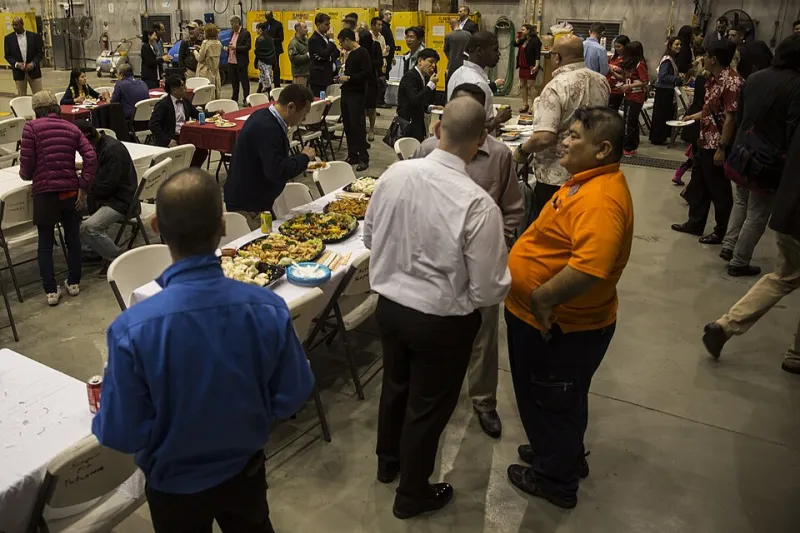
Aligning leadership on strategic direction. Rebuilding team cohesion after periods of rapid growth or organizational change. Onboarding new employees who have never met their colleagues in person. Hosting client relationships that require the trust-building depth that a video call cannot fully provide. These are the use cases driving demand, and they have almost nothing in common with the routine occupancy of a traditional office lease.
What Remote Teams Actually Need From a Venue
The requirements that distributed companies bring to conference and event facilities differ meaningfully from those of traditional corporate clients, and venues that have adapted to serve this segment have developed a clear picture of what matters most.
Seamless hybrid technology infrastructure ranks consistently at the top of the list. A remote-first company gathering 30 of its 200 employees in a single location still needs to connect meaningfully with the remaining 170. This requires conference facilities equipped with broadcast-quality audiovisual systems, reliable high-bandwidth internet, and room configurations that prevent the in-room participants from inadvertently dominating or excluding remote attendees. A space that accommodates hybrid participation as a first-class experience rather than an afterthought is a significant differentiating factor.
Flexible configuration across the day is equally important. Distributed teams gathering in person rarely follow a traditional conference schedule of static presentations delivered from a podium. Their agendas tend to alternate between whole-group sessions, small breakout work, informal conversation, and collaborative working time. Venues that can reconfigure spaces quickly and offer a range of room sizes within a single facility are considerably more useful than those designed around a single large meeting room format.
Proximity to transportation infrastructure matters more for distributed teams than for locally-based organizations. When attendees are flying in from Seattle, Denver, and Atlanta for a two-day leadership summit, the accessibility of the venue from a major airport is a practical constraint that shapes planning decisions. Business centers situated in metropolitan areas with strong air connectivity have benefited disproportionately from this trend.
Hospitality quality within the facility has also emerged as a differentiating factor. Distributed teams gathering in person place high value on shared meals and informal social time — experiences that are simply not available in their day-to-day remote work lives. Venues that offer high-quality catering, comfortable social spaces, and the kind of ambient environment that encourages people to linger and connect are better positioned to serve this market than those optimized purely for meeting efficiency.
The Economics of the Shift
For many distributed companies, the economics of flexible event space compare favorably to maintaining dedicated office leases. A company that gathers its full team twice per year and its leadership group quarterly can meet its in-person needs through venue rental at a fraction of the cost of carrying permanent real estate — particularly in high-cost markets like San Francisco, New York, or Boston.
This calculation has become increasingly attractive as commercial real estate costs have remained elevated in major US cities while the quality and availability of professional event facilities have expanded. The market has responded to growing demand with a broader range of offerings, from full-service conference centers with comprehensive event support to more flexible business hub arrangements that allow companies to reserve space on shorter notice and at varying scales.
For the venues themselves, remote-first companies represent a client segment with distinctive characteristics: high expectations for technology and service quality, strong repeat booking patterns when their initial experience is positive, and a tendency to scale their usage as their organizations grow. A distributed company that books a 30-person leadership retreat today may return six months later for a 75-person all-hands gathering.
How Business Hubs Are Evolving in Response
The most forward-looking conference and event facilities in the United States are actively redesigning their offerings to serve distributed organizations more effectively. This evolution is visible in several areas.
Technology investment has accelerated, with venues upgrading audiovisual infrastructure to support broadcast-quality hybrid experiences. Spaces that previously offered adequate video conferencing capabilities are being retrofitted with systems that approach studio-level production quality — because distributed companies have discovered that the quality of the hybrid experience determines whether remote participants feel genuinely included or merely tolerated.
Menu flexibility has expanded. Rather than fixed catering packages, venues serving remote teams are offering modular food and beverage options that can accommodate the varied schedules of working retreats — where a team might need a working lunch delivered to a breakout room at an irregular time rather than a formal seated meal at noon.
Booking flexibility has also improved. Distributed companies often operate with faster-moving planning cycles than traditional corporate clients. Venues that can accommodate shorter booking windows and offer transparent, flexible cancellation terms are more accessible to this segment.
The Deeper Implication
Behind the operational specifics of this trend lies a more fundamental insight about the nature of professional gathering in a distributed era. Physical space, for remote-first companies, has ceased to be the default container for work and become instead a deliberate instrument for achieving things that distributed environments cannot.
This shift elevates the strategic importance of every in-person gathering. When a team that works remotely 48 weeks per year convenes in a single location for four days, the quality of that experience carries enormous weight. The venue, the environment, and the design of the time together are not secondary considerations — they are central to whether the gathering achieves its purpose.
For professional conference centers and business hubs, this represents both a responsibility and an opportunity. The organizations walking through the doors today are not looking for a room with chairs. They are looking for an environment worthy of the rare and valuable thing they are doing: bringing their people together.